
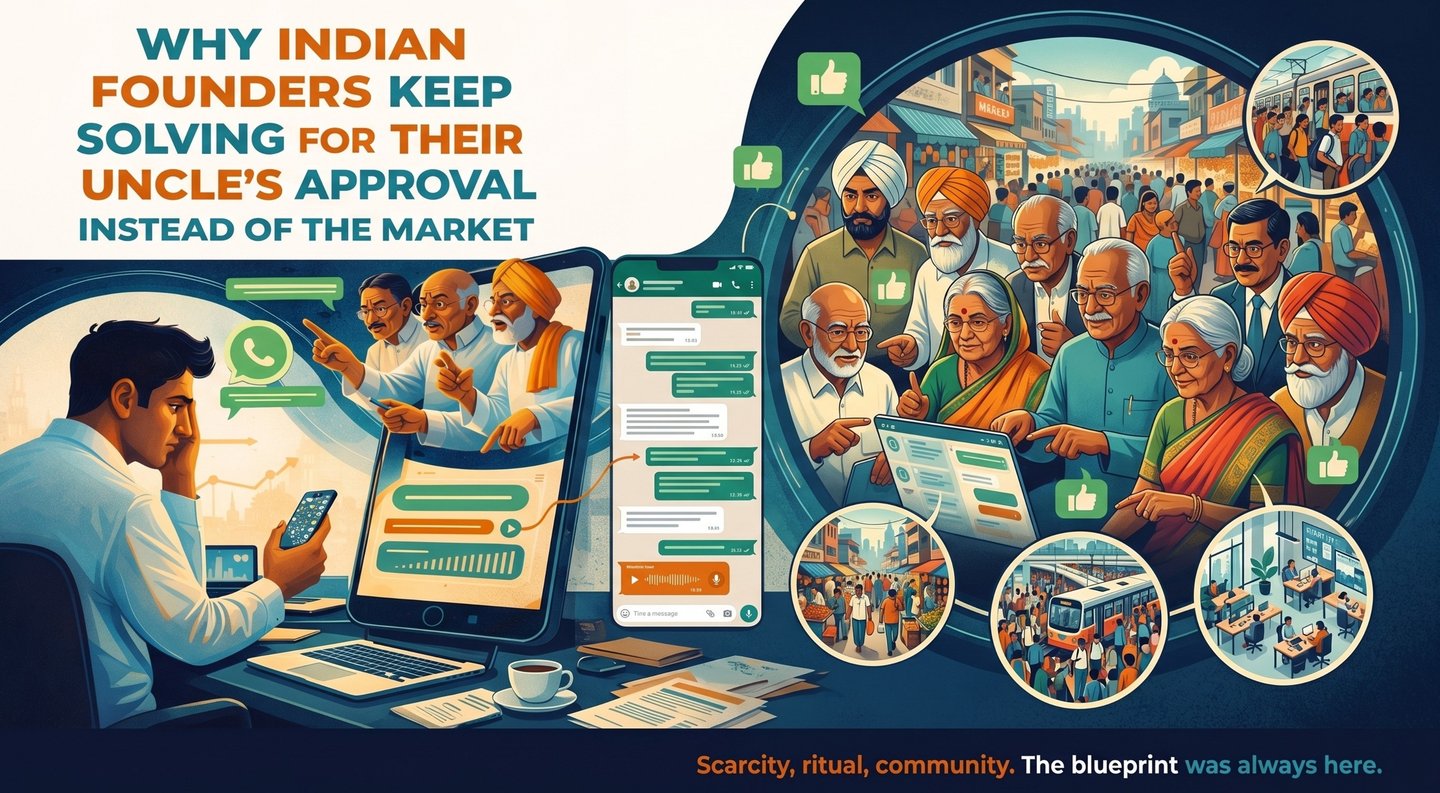
Why Indian Founders Keep Solving for Their Uncle's Approval Instead of the Market
BUSINESS
The invisible investor nobody talks about — the family WhatsApp group.
The product-market fit conversation in India is incomplete. Not because founders don't understand the concept, but because they are running it in parallel with a different, older, and significantly louder process: product-family fit. The quest to build something that the uncle who worked in a PSU bank for thirty-two years will understand, respect, and ideally mention at the next family gathering without adding the phrase "but when will it be profitable?"
This is not a joke. This is a structural feature of the Indian startup ecosystem and it shapes more product decisions than any amount of customer discovery research.
The family WhatsApp group is the shadow board of every Indian startup. It has opinions about the business model, the target market, the name, the logo, and the founder's life choices more broadly. It does not have equity. It has something more powerful: the ability to make the founder feel eight years old again at the dinner table. And that feeling influences decisions in ways that no one puts in the pitch deck but everyone experiences.
"The most common pivot in Indian startups is not product-market fit. It's founder-family fit. The product changes to be something the family can explain at weddings."
The first distortion is the explainability bias. Indian founders disproportionately gravitate toward business models that can be explained in one sentence to a non-technical relative. "It's like Uber but for X." The moment the business model requires more than one sentence, the founder starts simplifying — not for the investor, not for the customer, but for the imagined relative who will ask about it at Diwali. This kills nuance. Nuanced businesses are often the most defensible ones.
The second distortion is the prestige pivot. The founder starts building something genuinely innovative. Then the family weighs in — not with product feedback but with status anxiety about the category. "Why not build something in healthcare? Or fintech?" The founder pivots. The new business is more explainable, more crowded, and less interesting. The uncle is happy. The TAM is worse.
The third is the scale-as-validation trap. Indian families understand "we are in fifteen cities." They do not understand "we have 200 deeply engaged paying users." Niche is suspicious. Small is failure. This pushes founders to prioritise growth metrics that look good on a family update over unit economics that would actually build a sustainable business.
1 The number of people whose approval actually matters for your business. The customer. Not the uncle.
The solution is not to become the cold, rational, family-ignoring founder of Silicon Valley mythology. That person has their own pathologies and they are not a model. The solution is to develop enough clarity about your own judgment that you can receive the family input, acknowledge it warmly, and then continue doing what the market is actually asking for.
Build for your customer. Explain it to your family later. Or don't explain it at all — let the results do the translation. Revenue is a language every uncle speaks.
The approval you are actually chasing is not your uncle's. It is the market's. And the market does not attend family dinners.
Who Am I?
Brand positioning that cuts through family-board dynamics, market confusion, and the instinct to play it safe — this is the work The Editor does with founders who are ready to build for the right audience. The conversation starts with a single honest question: who are you actually building for?
Don't miss out on exclusive behind-the-scenes access, early demos, live streams and other benefits by subscribing to our newsletter.
Subscribe



+91 987 111 3110
pratik@unbranding.in
We are an AI Creative Agency, specialising in AI Advertising.
A Digihive Technology Pvt Ltd. Venture