
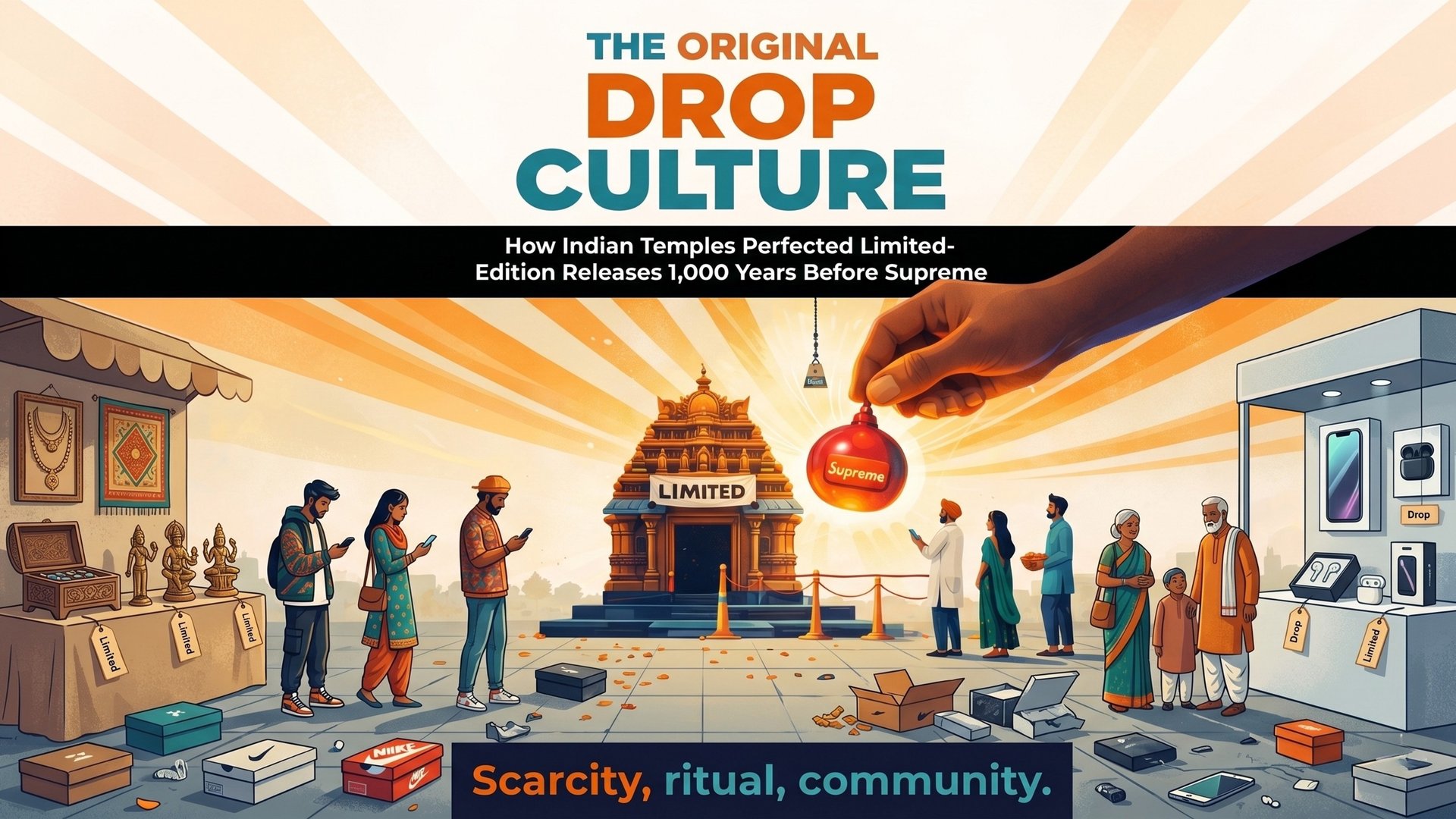
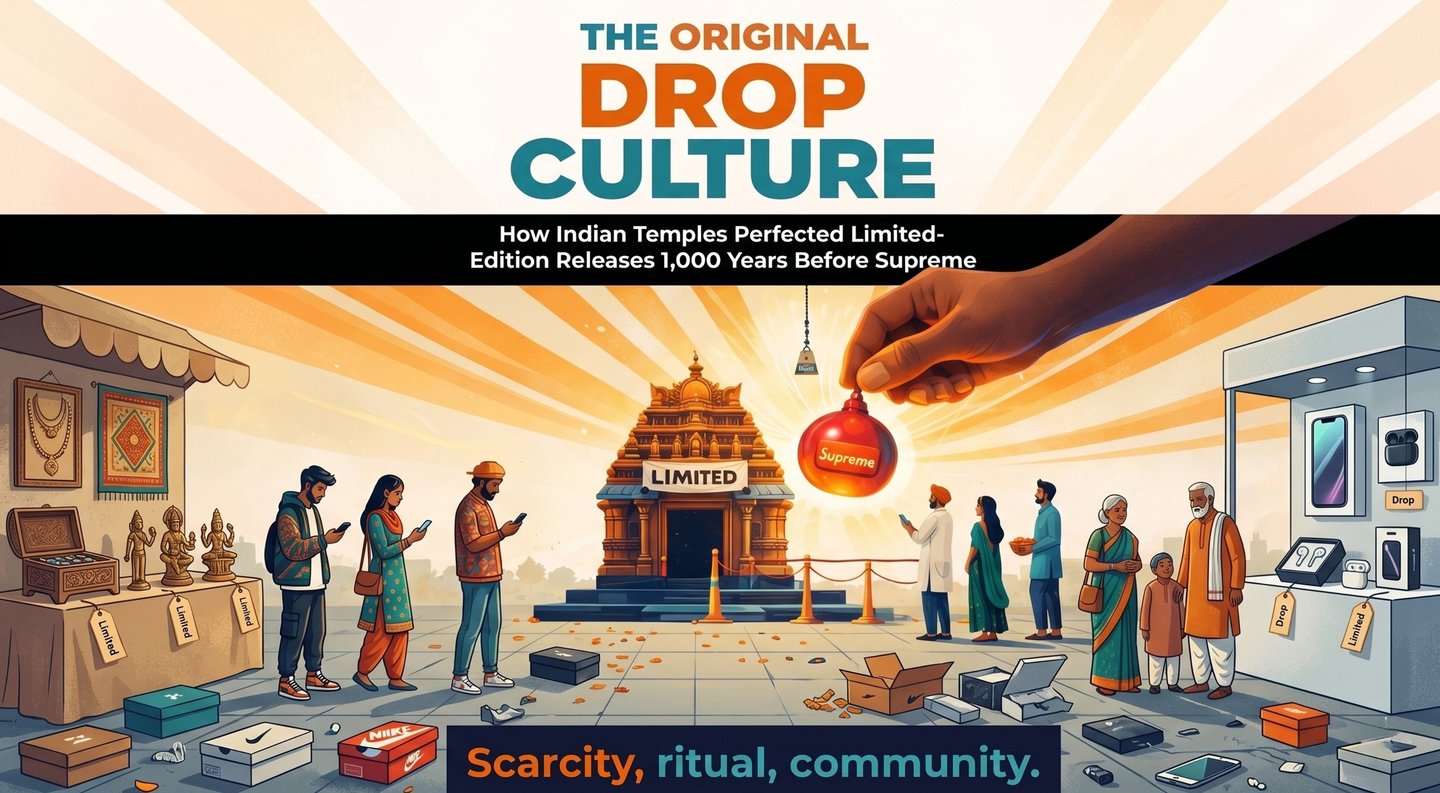
The Original Drop Culture: How Indian Temples Perfected Limited-Edition Releases 1,000 Years Before Supreme
CULTURE
Scarcity, ritual, community. The blueprint was always here.
Every year, in a small temple in Puri, thousands of people gather for a glimpse of something that is available for exactly fifteen days and then gone. The Rath Yatra. The idols. The prasad made from a specific recipe, distributed in limited quantities. People travel from across the country. They wait in lines that would make a sneaker release look like a casual Tuesday. They feel, upon receiving the thing, a combination of spiritual fulfilment and the particular satisfaction of having gotten something rare.
Hype Beasts, this is your origin story. And you are welcome.
The mechanics of what Supreme built in the 1990s — scarcity, ritual, community, the sense that getting the thing means something beyond the thing itself — were not invented in downtown Manhattan. They were refined over centuries in temple complexes, dargahs, festival calendars, and harvest rituals across the Indian subcontinent. The limited run. The one-day release. The queue as social experience. The object that derives its value from the difficulty of obtaining it. India had all of this. It just didn't have a marketing team to write a press release about it.
"Scarcity as strategy. Community as distribution. Ritual as brand experience. The temple economy invented drop culture. It just called it devotion."
Consider the mechanics of a major temple prasad. It is made in limited quantities — not as a growth hack, but because the recipe and process are sacred and cannot be scaled without losing the thing that makes it the thing. It is available only at specific times. It cannot be shipped to you; you must go to it. The going — the pilgrimage, the queue, the waiting — is part of the value. You don't just receive the prasad. You earn it. And then you take it home and give pieces to everyone you know, becoming a node in a distribution network that runs entirely on meaning.
That is a flawless brand experience. No agency needed.
The festival calendar is India's original content calendar. Diwali is not just a holiday; it is a multi-week brand activation with specific product categories, specific emotional triggers, and a built-in audience of 1.4 billion people primed since childhood to participate. The reason brand campaigns around Indian festivals feel hollow is that they try to attach to a ritual they did not create and do not understand at the level required to participate authentically. They use the colours and the keywords without understanding the grammar.
125+Years of uninterrupted drop culture operational excellence in Indian festival commerce. Supreme launched in 1994. The temple was there first.
Drop culture works because it satisfies three very deep human needs simultaneously: the need for belonging, the need for meaning, and the need for story. India's ritual economy has been satisfying all three needs for over a thousand years. It is not primitive. It is one of the most sophisticated systems for creating and sustaining perceived value that any culture has ever produced.
The Indian brands that will build lasting equity in the next decade are the ones that understand this not as a reference point but as a design principle. Not "let's do something for Navratri" but "let's build the kind of meaning into our product that makes people feel the way they feel when they finally get the prasad." That is a much harder brief. It is also the only one worth writing.
The blueprint was always here. It just required someone to look at it as a brand document instead of a religious one.
Brand strategy built from cultural intelligence — not borrowed frameworks — is The Editor's particular obsession. If your brand is trying to connect with Indian consumers at a level deeper than campaign relevance, that conversation starts here.
Don't miss out on exclusive behind-the-scenes access, early demos, live streams and other benefits by subscribing to our newsletter.
Subscribe



+91 987 111 3110
pratik@unbranding.in
We are an AI Creative Agency, specialising in AI Advertising.
A Digihive Technology Pvt Ltd. Venture